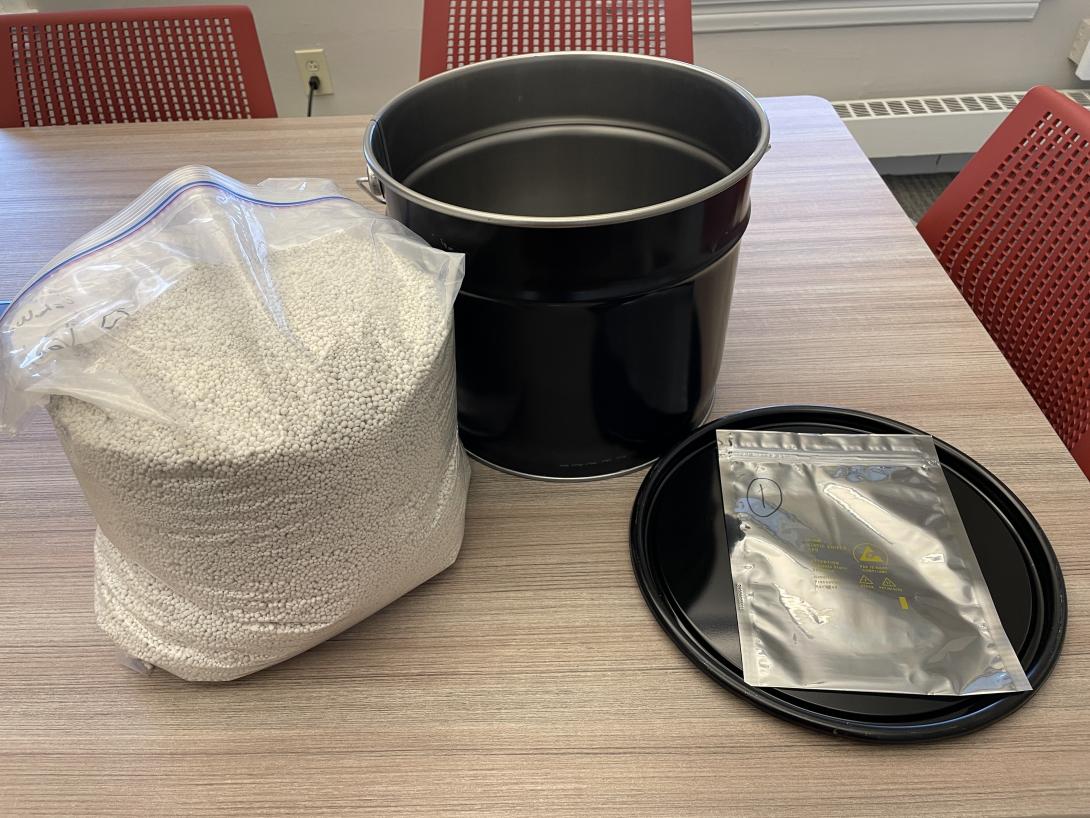
Lithium batteries pose significant hazards when they are damaged. Damaged batteries can undergo hazardous chemical reactions, begin smoking, and spontaneously combust. To prevent these dangerous outcomes for severely damaged batteries, EHS has developed lithium battery crash kits. Laboratory groups on campus are encouraged to build their own kits using EHS's list of crash kit materials and procedures to ensure safer containment of damaged batteries.
- 3.5 gallon steel pails - ULINE item S-22507BL
- 3.5/5 gallon steel pail lever lock lids - ULINE item S-21135BL
- 3.5 gallon ziploc style bags - Amazon Business item B0DBYZWLKD
- 6 x 8" anti-static bags - ULINE item S-2262
- Veolia Defend Pak thermal suppressant glass granules - Grainger item 855H38 - (fills (4) 3.5 gallon steel pail & ziploc bags)
For more information, please see our list of Lithium Battery Crash Kit materials.
Please follow these steps to ensure the safety of your self and others:
Fire prevention - Use lithium battery crash kits for batteries with punctures, in thermal-runaway, or producing smoke or gas.
- Open steel pail lid and remove the lever lock ring.
- Place damaged battery inside the anti static bag, which is labeled (1). The antistatic bag will prevent static interactions with damaged batteries and reduce the chance for a fire.
- Place the damaged battery inside the steel pail.
- Open the ziploc bag containing fire suppressant glass beads and pour it on top of the battery.
- Place the lid on top of the steel pail.
- Do not put the lever lock lid on the pail (doing so can trap potential battery gases).
- Contact EHS by phone or by emailing EHS@rpi.edu.
Batteries on Fire:
- Immediately exit the building using standard fire evacuation procedures.
- Pull a fire alarm pull station on your way out.
- Contact Public Safety at x6611 (518-276-6611) to provide details of its location.
Smoking Batteries:
- A smoking battery may turn into a fire at any moment.
- If safe to do so, follow the crash kit procedures in the section above.
- If a crash kit is not available, use a fire proof lithium battery bag and place it in an empty fume hood.
- If a fume hood is not available, place the battery in a location free of combustible and hazardous materials.
- Contact Public Safety at x6611 (518-276-6611)
Please contact EHS@rpi.edu for more lithium-based battery information.