Emergency eyewash stations & safety showers are critical elements of the first-response to exposure to chemical, biological, and radiological hazards. RPI’s Emergency Eyewash Station & Safety Shower Program’s primary goal is to ensure the functionality of emergency irrigation equipment across campus. The program includes the following elements:
- An inventory of emergency eyewash & safety showers across campus
- Collaboration with laboratories, EHS, and Facilities
- Testing and inspection of eyewashes, drench hoses, and safety showers on a weekly and annual basis
- Communication with affected parties if equipment is out of order
Approved safety showers and eyewash stations are available to personnel and students who utilize hazardous chemicals or materials. All individuals who could be exposed to hazardous chemicals or materials are expected to know the location and correct operation of safety showers and eyewash stations.
Emergency eyewash & safety showers are maintained using ANSI/ISEA Z358.1 - American National Standard for Emergency Eyewash and Shower Equipment. and OSHA 29 CFR 1910.151(c) guidance.
Emergency Eyewash Station & Safety Shower Program Elements
There are many types and models of emergency eyewash stations and safety showers. The American National Standards Institute sets standard requirements for each type of station. For specific dimensions, flow rates, etc., refer to ANSI/ISEA Z358.1 – American National Standard for Emergency Eyewash and Shower Equipment.
Each unit has a special function and a proper place. In areas where chemicals can burn both face and eyes, a facewash would be more appropriate than an eyewash. In areas where only small amounts of chemicals are used, a handheld drench hose may be more appropriate than an emergency shower.
Emergency Shower Station: The unit enables the user to have water cascading over the entire body. These units may be either ceiling mounted, wall mounted, or free standing. These units are also known as drench or deluge showers. Emergency showers should not be used as eyewashes, since the high rate of water flow may possibly damage the eyes.
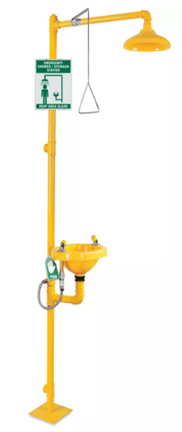
Emergency Eyewash Station: The unit is designed to flush and irrigate both eyes with two upward streams of water for a minimum of fifteen minutes.
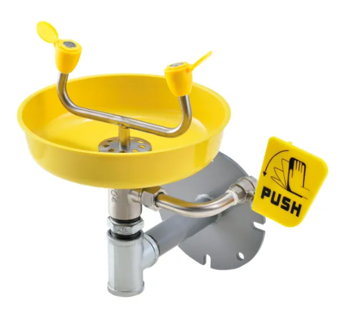
Emergency Facewash Station: This unit is similar to the eyewash fountains but also delivers extra streams of water to flush and irrigate both eyes and the face. They typically consist of a face spray ring, multiple spray heads, or enlarged eyewash heads.
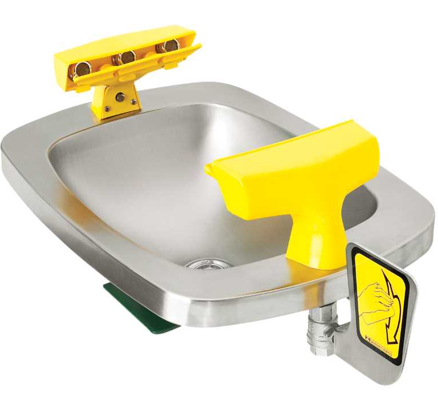
Self-Contained Eyewash Station: This eyewash unit is not permanently installed and must be replaced or refilled after use. These units should only be used in operations where there is a limited occupancy of short duration, or a permanent supply of potable water is not available.
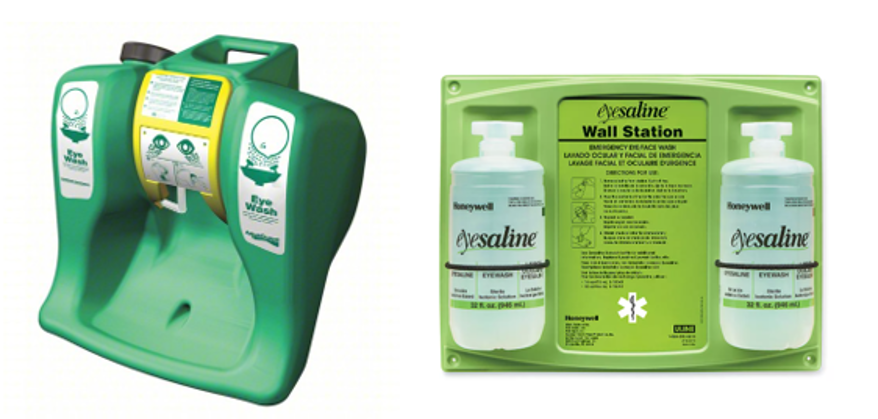
Handheld Drench Hose: This is a flexible hose that delivers an aerated flow of water to irrigate and flush the eyes, face, or parts of the body splashed by chemicals. Their relatively low rate of water flow limits their effectiveness since most models can only rinse one eye at a time, and the low water flow rate is insufficient for major skin contamination.
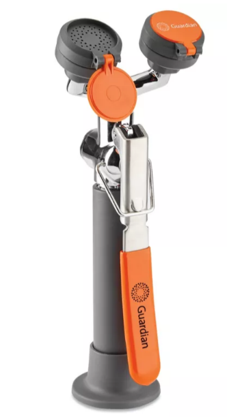
Before a laboratory worker begins working in the lab, the worker must be trained on the proper use of all emergency eyewash and safety showers present in the lab. Training should be provided so that each person is fully aware of the operation of ALL devices on the unit. Periodic retraining is necessary, particularly if a new type of unit is installed or new workers join the lab.
If the area is a high hazard or heavy chemical use lab, or if a lab would like in person training, EHS will present a training and demo session to demonstrate the importance of adequate protection, proper use, and proper testing and maintenance of the stations.
Training to laboratory workers must include:
- Locations of all units in the area
- The hazards present, and why the unit was installed
- Operating instructions for each unit
Eyewash stations are activated weekly to flush water through the lines to ensure the water is safe when someone has to use the unit. Secondly, it is important to activate eyewashes weekly to prevent tempering valves from becoming stuck. When you turn on an eyewash, look for any issues that might impact the functionality of the eyewash. The following are things that should be inspected during the weekly eyewash activation:
State of the Unit
- The unit should be free from broken caps, missing caps, cracks in nozzle heads, and nozzles blocked with calcification.
- None of the unit's plumbing connection points should be leaky.
- Units should not continue to run after deactivation.
- The unit should be stably mounted.
- The unit should be easy to activate and have a hands-free stay-open valve.
Water Pressure and Pattern
- Water streams need to simultaneously reach both eyes. Water pressure should not fluctuate widely.
- When placing a gloved hand in the water streams, does the pressure feel like it would be uncomfortable during 15 minutes of eye washing?
Temperature
- When placing a gloved hand in the water stream, does the temperature feel too hot?
- Is there any steam coming off of the water?
Accessibility
- The area surrounding the unit should be free from clutter.
- There must be less than a 10 seconds of travel time between the hazard and the unit.
- No more than one door should be in between the hazard and the unit.
State of Water
- After an initial flushing period of a few minutes, there should not be discoloration or particles in the water.
- If the initial water flow discolored, run the unit for a full 15 minutes to ensure that it clears up.
- If there are particles in the water, it could be hard water debris or filter decomposition.
Signage
- A sign should be present, visible, and in good condition.
All emergency eyewash stations, eye/face wash stations, safety showers, and combination units are required to be fully inspected annually by RPI Facilities to ensure conformance with the installation section of the Z358.1 standard for that type of equipment.
Weekly Activation Example Videos
These are examples of eyewash stations that do not meet the inspection requirements. If your eyewash is experiencing these issues, call FIXX (518-276-2000).
These are examples of eyewash stations that would pass weekly activation.
Testing Records
Safety showers will have tags where the year and month of the annual tests are recorded. Eyewashes typically do not have tags. Weekly inspection logs will be maintained by laboratory personnel and the RPI Facilities Department.
Facilities, Planning & Campus Services maintains an inventory of all emergency eyewashes & safety showers at RPI. Each unit is tagged with an inspection record tag, which reflects the annual inspection of the equipment. Employees use the Annual Eyewash and Safety Shower Inspection Form to complete the inspection.
Laboratory workers are responsible for ensuring emergency eyewashes are inspected and flushed weekly. All laboratory workers must document weekly inspections using the Eyewash Station Weekly Inspection Form.
Facilities employees are responsible for ensuring safety showers are inspected and flushed. All Facilities employees must documents inspections using the Safety Shower Inspection Form.
If a unit is not in working order, laboratory workers should contact FIXX (518-276-2000) immediately so the unit can be serviced.
Eyewash stations must deliver 0.4 gallons per minute (gpm) of uninterrupted tepid (60 to 100°F) water for 15 minutes. They are located in a well-lit areas and identified with proper signage. To protect the spray heads and flushing units from airborne contaminants, the units have covers over the heads that will pop off when water starts flowing. The valve of the eyewash activates in one second or less and will remain on until the user shuts it off.
Eyewashes are located no more than 10 seconds away from the hazard (approximately 75 feet). The path of travel from the hazard must be free of obstructions and located on the same floor as the hazard. Ideally, eyewash stations should be plumbed directly to a drain, but if they are not, a bucket must be used to contain the water during inspections.
All faculty, staff, and students who might be exposed to a chemical splash must be trained in the use of eyewash equipment.
In the event of an emergency,
- Activate the eyewash station by pushing the handle back. Hold both eyelids open with thumbs and forefingers.
- Roll eyeballs back and forth so the water can reach all surfaces of the eye and under the eyelid.
- Flush eyes for 15 minutes.
- After using an eyewash station, seek immediate medical attention for further treatment.
Personal eyewashes or eye saline are supplementary, do not meet requirements of plumbed eyewash equipment, and are not a substitute. Inspection of the unit must be accomplished according to the manufacturer's instructions. These instructions are typically located on the tank of the unit. It is recommended that these instructions be recorded in additional locations as wear, moisture, weather, etc., may deface the original.
Pressurized tanks usually have minimum and maximum pressures and water levels for the tank to work properly. Gravity fed systems must have a minimum level of water. The water in these units must be changed periodically even if the unit has not been used. This will eliminate the buildup of bacteria.
Emergency showers must deliver an uninterrupted flow equal to 20 gallons per minute (gpm) for a minimum of 15 minutes of tepid (60 to 100°F) water. The center of the safety shower spray pattern must be located at least 16 inches from any obstruction. The valve of the safety shower should activate in one second or less and remain on until the user shuts it off.
Safety showers are located no more than 10 seconds to reach (approximately 75 feet from the hazard).
They are located in well-lit areas and identified with a signage. The path of travel from the hazard must be free of obstructions and located on the same floor as the hazard.
All faculty, staff, and students who might be exposed to a chemical splash must be trained in the use of safety shower equipment. If there is any question about the severity of a chemical exposure, immediately use the safety shower. There is no time for modesty or hesitation in the event of a chemical exposure.
In the event of an emergency,
- Immediately move under the safety shower and pull the handle down.
- Strip any contaminated clothing, jewelry, or personal protective equipment off.
- Stand under the shower for 15 minutes, flushing contaminated areas. Tilt the head back and hold open the eyes if exposed.
In the event of chemical exposure, do not worry about making a mess. Water can easily be cleaned up. The safety of the exposed person is always the primary concern.
After using an emergency shower, seek immediate medical attention for further treatment.