Local exhaust ventilation is the primary method used to control inhalation exposures to hazardous substances. Chemical fume hoods are the most common local exhaust method used in laboratories at Rensselaer.
When operating and used properly, chemical fume hoods:
- Prevent flammable, toxic and/or offensive vapors, fumes and odors from entering the general laboratory.
- Provide a physical barrier between the laboratory worker and the chemical experiment, when the hood sash is lowered.
- Provide a certain degree of spill containment in the event of a release.
- Confirm that the fume hood is operational either by checking the air flow gauge if so equipped, or “floating” a piece of tissue paper to check air flow. Face airflow should be between 90 and 110 feet per minute (fpm).
- To avoid turbulence at the sash edge and to allow for greater protection, keep your work at least 10 cm (4 in.) back from the edge of the sash.
- Instruments and/or apparatus should be raised off of the floor of the work surface to allow proper airflow through the hood.
- Fume hoods should not be used as storage cabinets for chemicals or equipment.
- Waste containers in fume hoods must be properly labeled and closed, except when adding to the container.
- Apparatus in hoods should be fitted with condensers, traps or scrubbers to contain and collect waste solvents, toxic vapors or dusts, before the exit gases are released into the hood system.
- The sash should always be kept in the lowest possible position, thus minimizing the face opening and exposure potential.
- Foot traffic at the face of the fume hood should be kept to a minimum as individuals walking in front of the hood can disrupt the airflow within the hood.
- Items such as hot plates, controllers, open flame devices and electrical connectors must be certified, and labeled, as being intrinsically safe for operation within a chemical fume hood.
- Your head should never cross the plane of the hood sash when you are dismantling equipment or at any other time.
Temporary shutdowns of fume hoods may be required for scheduled inspections, maintenance and roof access where exhaust system shutdown is required.
Temporary Shutdown of Fume Hoods: Instructions for Laboratory Personnel must be followed when laboratory personnel are informed by Facilities Customer Service Center (FIXX), Environmental Health & Safety (EHS), or a Building Coordinator that a temporary shutdown of fume hoods is necessary.
Chemical Fume Hood Shutdown Notice may be posted by Building Coordinators or laboratory supervisors to inform laboratory personnel and building occupants that the fume hood may not be used during the shutdown timeframe.
A number of buildings require fume hood exhaust ventilation to be shut down for the roof to be accessed. Roof Access Procedure - Fume Hood Shutdown identifies the steps required for a shutdown of this equipment to occur and can be used as a reference for when a fume hood shutdown occurs.
Fume hoods are an essential safety and engineering control in laboratories, but they require significant energy to operate. A standard six-foot hood exhausting air at 100 linear feet per minute (LFM) and with the sash open 18 inches can exhaust nearly 1.5 million cubic feet of conditioned air every day. Because of this, laboratory ventilation systems can account for up to half of a lab’s total energy use, and a single hood can consume as much energy as 3.5 homes! Simply closing the sash when the hood is not in use can reduce energy consumption by as much as 40%.
Because fume hoods constantly exhaust air to the outdoors, minimizing sash height is the most effective way to reduce their energy demand. The sash also serves as a key safety barrier and should be opened only when setting up or adjusting an experiment.
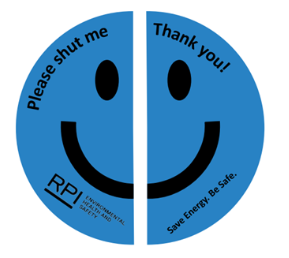
To support safer and more sustainable laboratory practices, Environmental Health & Safety (EHS) has placed Shut the Sash reminder stickers on all variable-flow chemical fume hoods. The stickers provide a simple, visible prompt to close the sash whenever the hood is not actively in use.
Will these stickers actually save energy?
Actual savings depend on lab users, but U.S. Department of Energy research has shown that reminder stickers significantly improve both laboratory safety and energy efficiency.
What other lab practices can reduce energy consumption?
- Use the “Ventilation Start” button only in emergencies. This function drives air exchange to maximum capacity and is extremely energy intensive. Pull the button out to deactivate it.
- Do not store chemicals in a fume hood. Store them in an appropriate safety cabinet, which does not require high airflow.
- Use right-sized equipment and turn it off when not in use, particularly equipment that maintains a constant temperature (hot or cold), as it consumes substantial energy.
How do I use these stickers or request more?
EHS staff have placed Shut the Sash stickers on fume hoods across campus, typically on the right or left side of the hood. When the sash is aligned with the smiley face, you’ll know it is fully and safely closed.
If your lab installs new equipment or you believe a hood was missed, please contact EHS at ehs@rpi.edu and we will be happy to provide additional stickers.